
Choosing your binoculars: our tips for finding the ideal model.
💡 The right reflex: Define your usage before looking at the technical specifications. The best model is the one that matches your practice.
Main use
- Hiking / Travel
- Ornithology / Versatile
- Safari / Versatile
- Ornithology / Wildlife observation
- Show / Concert
- Navigation / Boat
 THE CONCEPT-FIELD
Preparation of your binoculars — The commitment of Optique Perret
Before each delivery, your binoculars benefit from a complete optical and mechanical inspection by us — to guarantee you a perfectly adjusted instrument, ready to use from the first use.
To enhance your experience in the field, we add a selection of essential accessories free of charge:
1 : Attachment of the strap — Smart-O'Strap© system
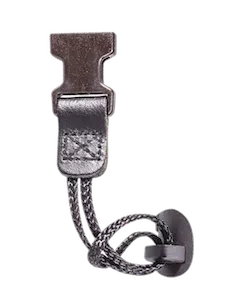 Your binoculars are equipped with our exclusive strap Smart-O'Strap©, designed to combine comfort, safety, and freedom of movement:
- Safety — The strap and the eyepiece cover remain attached to the binoculars in all circumstances
2 : Attachment of the comfort adapter
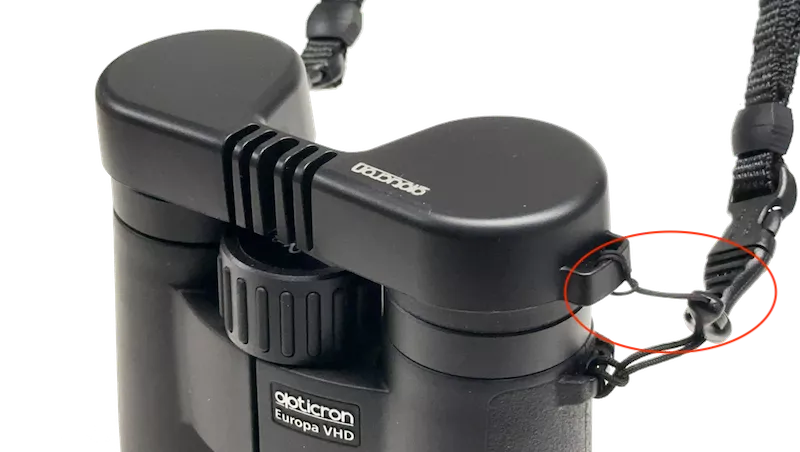 Your binoculars are equipped with a comfort adapter on the eyepiece covers, designed according to our Comfort Concept — for a more pleasant grip and optimal support during your observation sessions.
- Freedom — Total freedom of movement for the eyepiece covers
3 : Your binoculars are equipped with our exclusive anti-slip system — an innovation from Optique Perret
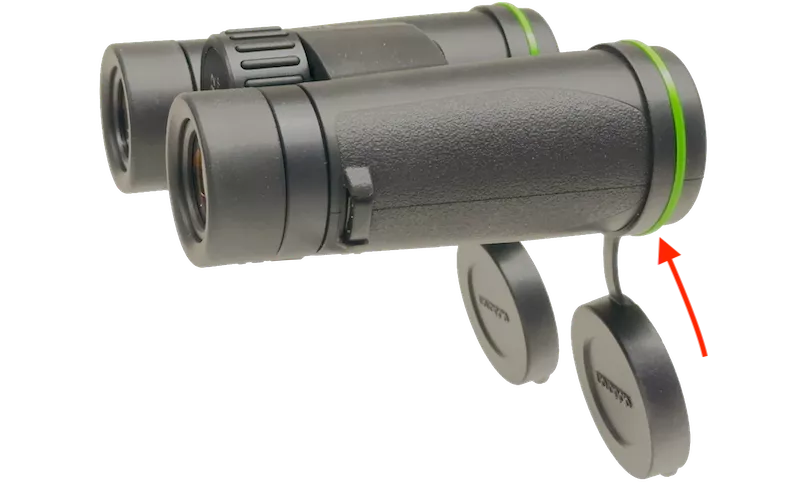
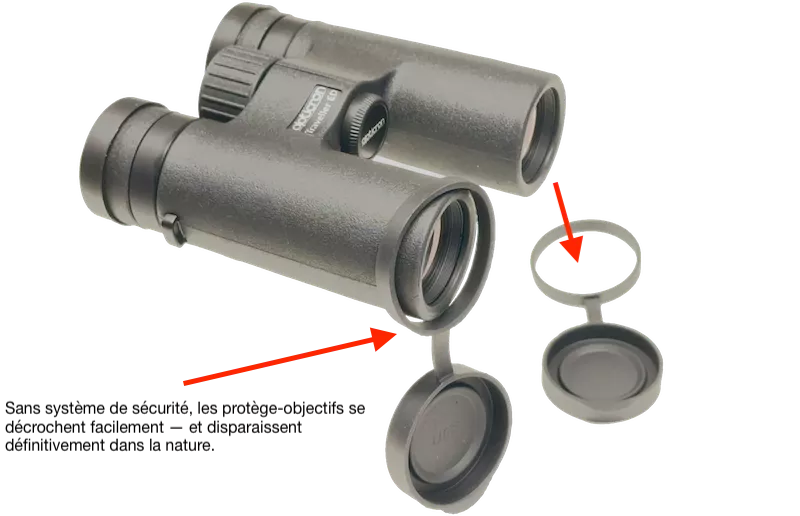
Your binoculars are also equipped with our exclusive loss prevention device for the objective covers — so you will never lose them in the field again.
- Safety — The objective covers remain attached to the binoculars.
What do the numbers on binoculars mean?
8x | Magnification — the object appears 8 times closer
42 | Diameter of the objective in millimeters
The larger the diameter, the better the performance in low light (dawn, dusk, undergrowth) — but the heavier and bulkier the binoculars are to carry
The magnification: how does it work?
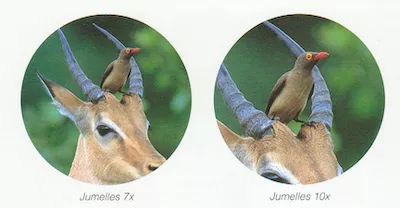 An 8x magnification brings the observed object eight times closer than the naked eye. However, a high magnification has two downsides: it reduces the field of view and brightness and amplifies the shakes, making stabilization more difficult.
Concrete example: with 8x binoculars, an object located at 1000 m will seem as close as if it were at 125 m.
- Comfortable (7x, 8x) / Multi-purpose
- Strong (10x, 12x) / Long distances
The diameter of the objective: brightness and bulk
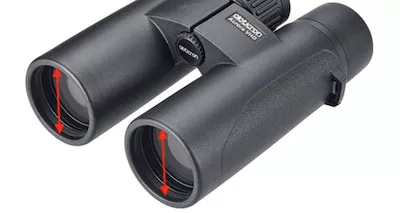 The diameter of the objective corresponds to the width of the front lens. It directly influences two essential characteristics of binoculars: size, weight, and brightness (at equal magnification). We classify binoculars as follows:
- Pocket (20 - 25 mm) | Pocket binoculars | Adequate brightness
- Compact (30 - 32 mm) | Compact, versatile format | Good brightness
- Medium (40 - 42 mm) | Standard format, wildlife | Very good brightness
- Large (50 mm and more) | Bulkier binoculars | Excellent brightness
From a diameter of 30 mm, binoculars reveal their full potential for ornithological or wildlife observation. Below that, a small objective will suffice for travel or shows.
💡 Important to know
The larger the diameter, the more light the objective captures — and the brighter the image will be, especially in difficult conditions: dawn, dusk, undergrowth, overcast weather. In bright sunlight or at equatorial latitudes, a large diameter becomes unnecessary: the pupil of the eye naturally constricts and cannot utilize all the available light.
The weight
For hiking or extended observation sessions, the weight of the binoculars becomes a decisive criterion. Binoculars that are too heavy quickly become uncomfortable or even discouraging to use.
To prefer: a light and compact model for itinerant activities, while a heavier model is acceptable for stationary use.
The exit pupil: the secret of brightness
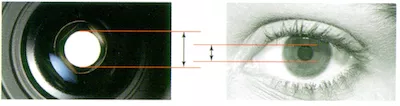 The exit pupil is the small circle of light you see when you hold your binoculars at arm's length, eyepiece facing you.
A large exit pupil optimizes brightness but is limited by the natural dilation of your eye: 8 mm in children, 6 mm in young adults, 4 mm after 50 years.
An exit pupil larger than that of your eye provides no additional gain in brightness. Therefore, there is no need to aim for the largest diameter if your eye cannot take advantage of it.
Field of view / Sharpness of the field
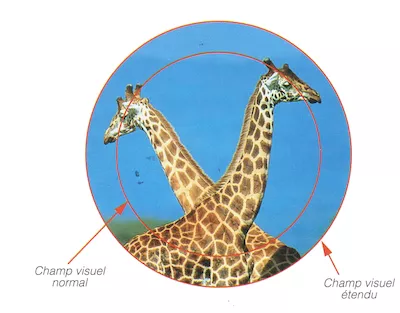 The field of view refers to the width of the visible landscape through your binoculars, measured at 1,000 meters distance. It is expressed in meters (m). A wide field of view facilitates spotting and allows you to easily follow a moving subject.
Example: A field of view of 114 m means that you perceive a width of 114 meters at a distance of 1,000 meters.
When using binoculars, the gaze naturally focuses on the center of the image. However, the optical quality at the periphery varies significantly from model to model — distortions, edge blur, chromatic aberrations.
A good model offers a sharp image across the entire field of view, not just in the center.
A criterion often overlooked when purchasing, but which makes all the difference in everyday use.
The eye relief
The eye relief corresponds to the distance between the eye and the eyepiece. A short eye relief forces you to press your eye against the eyepiece to enjoy the entire field of view. For glasses wearers, a relief of at least 15 mm is essential for comfortable observation.
Important to know: An eye relief of at least 15 mm is recommended for observing without removing your glasses.
The optical quality
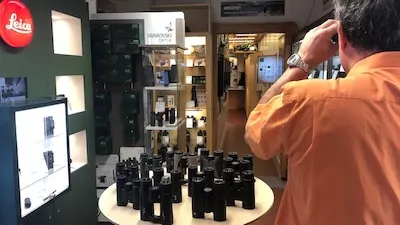 The optical quality of a pair of binoculars is assessed based on four essential criteria:
- Distortion | Is the image faithful, without distortion?
- Edge sharpness | Does the image remain sharp to the edges of the field?
- Color rendering | Are the colors natural and true to life?
- Detail resolution | Are fine details well defined?
Our advice: these qualities can really only be appreciated under real conditions. Come test our models in-store — it's the best way to find the binoculars that truly suit you.
The optical coating
Almost all binoculars are equipped with an anti-reflective coating on their lenses, designed to improve light transmission and image clarity. But not all coatings are equal — the quality of this coating varies significantly from model to model and directly affects the sharpness and brightness of the final image.
A good anti-reflective coating means a brighter, more contrasted, and more color-accurate image.
After-sales service
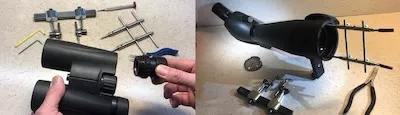 We know that an instrument used in the field is exposed to the uncertainties of daily life — shocks, falls, natural wear. That’s why we offer attentive after-sales service, in close collaboration with manufacturers, to ensure the replacement of wear parts and necessary repairs at controlled costs.
The warranty — what it really covers
The warranty is often misunderstood. It is by no means a comprehensive insurance: it only covers manufacturing defects and faults, independent of any user intervention or use.
It does not apply in the event of shock, fall, normal wear, or improper use according to the manufacturer's recommendations.
In practice, a manufacturing defect — on a pair of binoculars, for example — usually manifests itself during the first uses. As for the displayed warranty duration, it is more of a sales argument than a technical reality: neither shocks nor wear are covered, regardless of the announced duration.
In summary: use your instrument with care, and the after-sales service will rarely need to intervene.
The advice of the experienced ornithologist
An experienced observer never chooses an instrument at random: he always buys the one he has personally tried and tested. Because a device taken out of its packaging may conceal an imperceptible defect without the conditions of a real optical test. A good reason to come visit us in-store.