
Choosing your monocular: our tips for finding the ideal model.
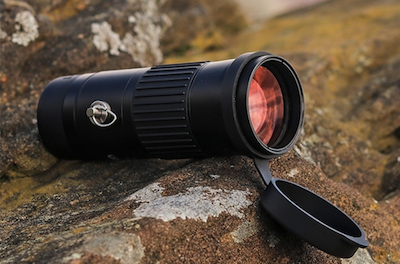 Compact and discreet, the monocular easily slips into a jacket pocket — ideal for quick observations. Be sure to choose a magnification suitable for your usual observation distance.
Monoculars are designed for specialized applications such as entomology, while also serving as excellent field optics for those who prioritize lightness and compactness. Available in various sizes and formats, they come with accessories dedicated to macro observation of flora and fauna.
 Entomology is the branch of zoology dedicated to the study of insects — their morphology, behavior, life cycle, and classification. In the context of monoculars, this refers to close and detailed observation of insects in their natural environment — butterflies, beetles, dragonflies, etc.
💡 The right reflex: Define your usage before looking at the technical specifications. The best model is the one that fits your practice.
Main uses
- Hiking / Travel
- Ornithology / Versatile
- Butterflies / Insects
- Marine / Boat
- Visual aid for the visually impaired
Selection criteria
The essential selection criteria are weight, bulk, magnification, and the shortest focusing distance — four parameters that allow you to select the model best suited to your activity.
Weight
For hiking or prolonged observation sessions, weight becomes a determining factor. A monocular that is too heavy quickly proves uncomfortable, even discouraging to use.
To prefer: a light and compact model.
Bulk
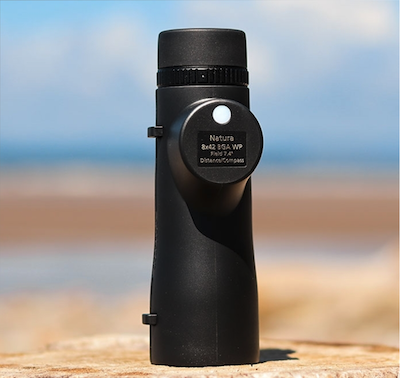 Bulk is judged from two angles: compact enough to always be within reach, but generous enough to fit comfortably in the palm of your hand.
To prefer: a model that fits well in the hand.
Magnification: how does it work?
A 7x magnification brings the observed object seven times closer than the naked eye. However, a high magnification has two downsides: it reduces the field of view and brightness and accentuates the shakes, making stabilization more challenging.
Concrete example: with a monocular 7x, an object located at 50 cm will appear as close as if it were at 7 cm.
- Panoramic (4x to 6x) / Concert, theater, insects
- Comfortable (7x, 8x) / Multi-purpose
- Strong (10x) / Long distances
To prefer: the lowest magnification suitable for your use.
Minimum focusing distance
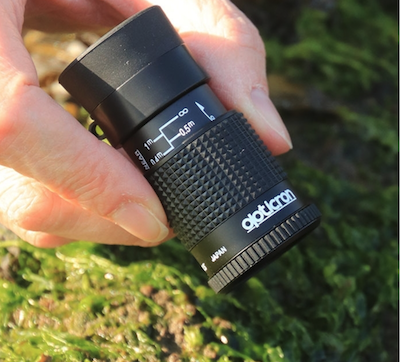 A short focusing distance allows you to observe fascinating subjects up close without disturbing them — moving insects, small wildlife, delicate flora… A truly infinite playground!
To prefer: a short focusing distance associated with a panoramic magnification.