
Telescope: How to find the model that truly matches your desires?
Which magnification to choose?
Depending on atmospheric conditions, the most commonly used magnifications range from 30x to 130x. The golden rule: the magnification that offers the maximum detail corresponds to the diameter of the objective expressed in millimeters.
Example: A telescope with a 100 mm diameter reaches its optimal detail level at 100x.
Beyond this value, the image is indeed enlarged — but the disadvantages quickly outweigh:
- it becomes darker
- it is more difficult to focus
- it does not reveal more details
To remember: excessive magnification harms observation quality. Better to have moderate magnification with a sharp and bright image than an enlarged but degraded image.
It is thanks to the eyepieces that one varies the magnification of the telescope.
The magnification is obtained through the eyepieces placed on the instrument. This allows for revealing an astonishing amount of details — provided one chooses a magnification suitable for the observed object.
For a complete observation of the sky, three eyepieces with complementary magnifications are generally recommended:
- Eyepiece Panoramic — spotting, wide fields, star clusters | Magnification between 30x to 50x |
- Eyepiece Medium — planets, Moon, small objects | Magnification between 80x to 100x
- Eyepiece Strong — fine details, double stars | Magnification between 120x to 150x |
How to calculate the magnification?
The magnification is obtained by dividing the focal length of the telescope by the focal length of the eyepiece:
Magnification = Focal length of the telescope ÷ Focal length of the eyepiece
Example: For a telescope with 700 mm focal length and an eyepiece of 10 mm: 700 ÷ 10 = 70x
Which optics to choose?
The astronomical telescope: simplicity and performance
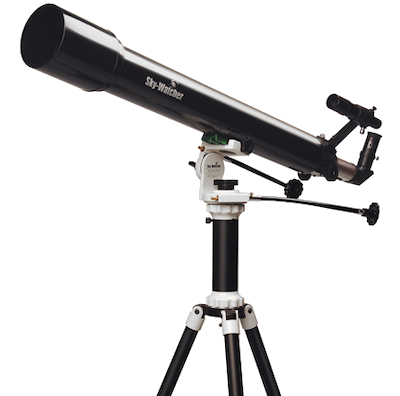 The astronomical telescope is equipped with a lens objective: the observer stands behind the instrument and aims directly at the object to be observed. Versatile, it is suitable for both celestial and terrestrial observations.
Images of remarkable purity. Unlike mirror telescopes, the telescope has no central obstruction — which translates, in high-quality models, into optimal contrast and exceptional definition. Ideal for revealing the subtle details of the Moon, the cloud bands of Jupiter, or the divisions of Saturn's rings.
An instrument without constraints. Forget complex adjustments: the astronomical telescope is ready to use right out of the box. Its closed tube protects the optics from dust — a simple occasional maintenance of the lenses is sufficient.
Double use. Add a corrector prism and transform your telescope into a powerful terrestrial observation instrument — perfect for nature, ornithology, or landscapes.
Its strengths:
- Offers beautiful images of the Moon and planets (Saturn, Jupiter)
- Perfectly suited for observations from the city or suburbs
- Convenient to set up on a balcony
- Usable for celestial and terrestrial observations (with a corrector prism)
- A telescope easily supports a high magnification equivalent to double its diameter in millimeters — i.e. 140x for a telescope of 70 mm.
The hybrid Cassegrain-type telescopes
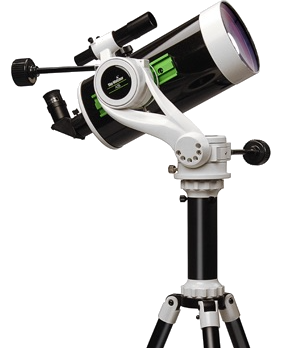 The Cassegrain telescope combines mirrors and lenses within a compact and lightweight tube. Like the astronomical telescope, the observer stands behind the instrument and aims directly at the observed object. Versatile, it is suitable for both celestial and terrestrial observations.
Its strengths:
- High-resolution images with great finesse
- Compact and lightweight tube, easy to transport and set up
- Stunning images of the Moon and planets (Saturn, Jupiter)
- Capable of observing deep sky objects — nebulae, galaxies, and star clusters
- Usable for celestial and terrestrial observations
- The long focal length of Cassegrain allows for easily achieving high magnifications.
The Newton telescopes
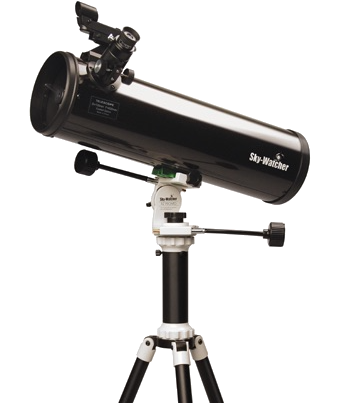 The Newton telescope operates using a concave mirror that collects and reflects light. Observation is done from the side, perpendicular to the targeted object. Its image being inverted, it is exclusively dedicated to astronomy.
Its strengths:
- Excellent for observing deep sky objects — nebulae, galaxies, and star clusters
- Offers beautiful images of the Moon and planets (Saturn, Jupiter)
- Allows access to a large diameter at an affordable price
Which astronomical mount to choose?
Most telescopes come with a tripod and a sturdy mount, positioning the eyepiece at eye level for optimal comfort. There are two types: the altazimuth mount, simple and intuitive due to its horizontal and vertical movements, and the equatorial mount, aligned with the Earth's axis and ideal for precise tracking of celestial bodies.
⚠️ Beware of tabletop telescopes: very convenient for travel, they require an elevated surface — without a table, observation is done at ground level, which quickly becomes uncomfortable.
The altazimuth mount
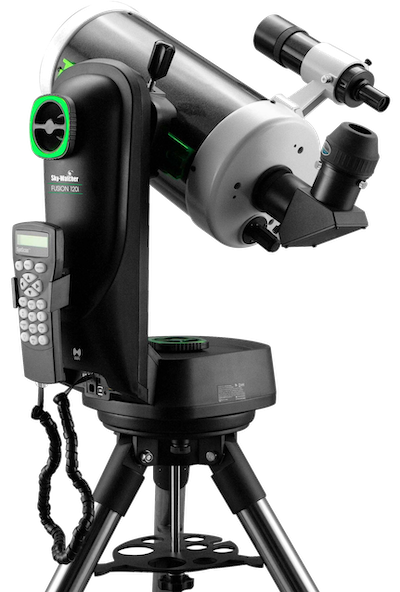 The altazimuth mount is the simplest and most intuitive to use: it allows left-right and up-down movements, making it perfectly suited for both celestial and terrestrial observations.
Next-generation models incorporate motorization for automatic tracking of celestial objects and are even available in a GoTo Wi-Fi version — allowing you to point and track a star with just a few taps from your smartphone.
Its strengths:
- Intuitive and easy to handle
- Light and compact, ideal for transport
- Available with micrometric manual movements for precise alignment
- Compatible with motors and GoTo Wi-Fi system
The equatorial mount
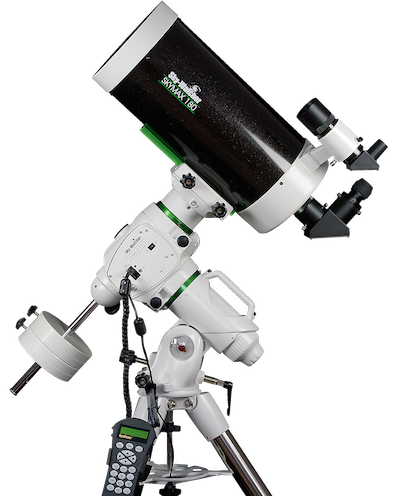 The equatorial mount allows for tracking the movement of celestial bodies on a single axis, aligning with the Earth's rotation. It requires a precise alignment on the North Star — an essential step to fully enjoy its performance. It is also available in a GoTo version.
Its strengths:
- Precise tracking of the drift of celestial objects — provided that the alignment is done carefully
- Available with micrometric manual movements for fine pointing
- Compatible with motors and GoTo system, controllable by hand controller or Wi-Fi
The diameter: the essential to remember
The most determining specification of a telescope is not its magnification, but its ability to collect light — defined by the diameter of the objective, whether it is a mirror or a lens. The larger the diameter, the more light the instrument captures and reveals details… but the heavier and bulkier it becomes.
55 to 76 mm — The initiation
To observe the craters of the Moon, the rings of Saturn, or the dance of Jupiter's four moons, a telescope of 55 to 76 mm offers remarkable results for beginners. A telescope easily supports a high magnification equivalent to double its diameter in millimeters — i.e. 140x for a telescope of 70 mm.
80 to 130 mm — More details
A telescope of 80 to 102 mm or a Newton of 130 mm reveals more details about the planets and the Moon, as well as bright nebulae and sparkling star clusters.
150 to 300 mm — The deep sky
Under a dark and starry sky, an instrument of 150 to 300 mm offers sumptuous images of faint star clusters, nebulae, and distant galaxies. The larger the aperture, the finer the details — both on the planets and in the deep sky.
The weight
A criterion not to be neglected: an instrument that is too heavy quickly becomes a burden in the field. For astronomical outings, prefer a compact and lightweight model that is easy to transport and set up.
Our advice: prefer an instrument whose total weight is between 7 and 12 kg — the best compromise between stability and maneuverability. Below this, stability may prove insufficient; above 15 kg, setting up and using it daily requires unwavering motivation and passion.
The quality of the instrument
The quality of a telescope is assessed on three essential and inseparable criteria:
The optical quality — it determines the sharpness of the image and the precision of the observed details.
The mechanical quality — it ensures the fluidity and precision of the movements for centering and tracking celestial objects.
The stability — it ensures the robustness of the mount and limits vibrations for comfortable and clear observation.
In conclusion
Choosing a telescope is primarily about finding the right balance between performance and practicality. Larger models undoubtedly offer more efficiency, but the more compact ones often prove to be simpler to use on a daily basis.
The best telescope? It is simply the one you will take out the most often.