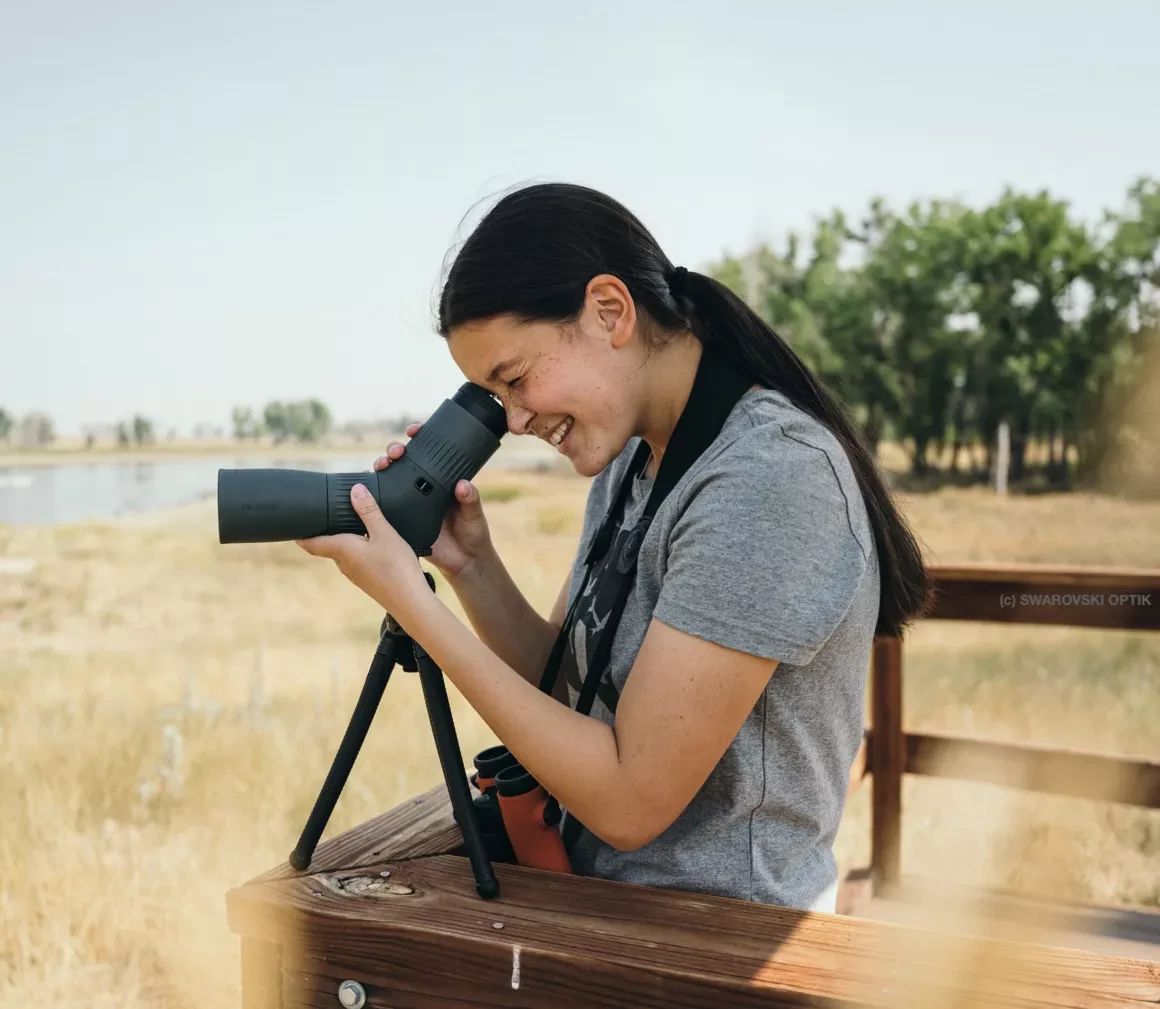
Spotting scope: how to find the model that truly meets your needs?
💡 The right reflex: Define your usage before looking at the technical specifications. The best model is the one that fits your practice.
Main use
- Hiking / Travel
- Ornithology / Wildlife observation
- Terrace / Viewpoint
- Sport shooting
 The spotting scope is the natural complement to binoculars – together, they form the indispensable duo for any experienced observer.
💡 The right reflex: Binoculars are used for scouting, the spotting scope for fine observation. Both perfectly complement each other for an optimal experience in the field.
The spotting scope
More powerful than binoculars, the spotting scope requires the use of a tripod for a stable and comfortable image. It is naturally imposed from a fixed observation point when an approach at close range is impossible.
Its preferred terrain: wildlife observation. At long distances and without disturbing the subjects, it reveals details impossible to perceive with the naked eye or even with binoculars.
The objective diameters
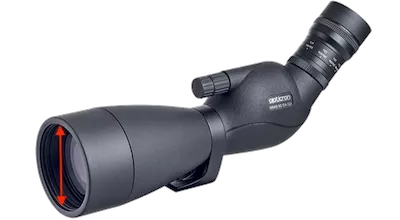 The diameter of the objective determines both the brightness and the bulk of the spotting scope.
Models with small diameter (50 to 65 mm) are lightweight and compact, easy to carry in the field. Their brightness is quite sufficient for daytime observation.
Models with large diameter (66 to 100 mm) offer significantly higher brightness, ideal for observing in low-light conditions. Their counterpart: a larger size and weight, which require a more robust tripod.
In summary: small diameter for mobility, large diameter for performance – each to their own use.
The eyepieces and magnifications
The most common and versatile magnifications are between 20x and 50x: they guarantee excellent optical quality, a bright and precise image. Beyond that, the image tends to darken and lose sharpness.
To illustrate the power of a 50x: an object located 1,000 m away will appear as close as if it were 20 meters away – that is, 1,000 m ÷ 50x.
When the eyepieces are interchangeable, they allow for adjusting the magnification according to the situation. Zoom eyepieces go even further by offering a variable magnification range without changing the eyepiece – a very practical solution in the field. Their only compromise: a slightly smaller field of view than that of a fixed focal length eyepiece.
Brightness and exit pupil
The exit pupil is that small circle of light you see when looking at the eyepiece from a few dozen centimeters away. Technically, it is the diameter in millimeters of the image projected by the objective through the eyepiece – and the larger this diameter, the brighter the image.
It is simply calculated by dividing the diameter of the objective by the magnification:
Example: a spotting scope 40x60 → 60 ÷ 40 = 1.5 mm – a value just sufficient for daytime observation.
By comparison, an exit pupil of 3 mm or more will be much more comfortable in low-light conditions, such as at dawn or dusk.
The special ED, HD, and APO glasses
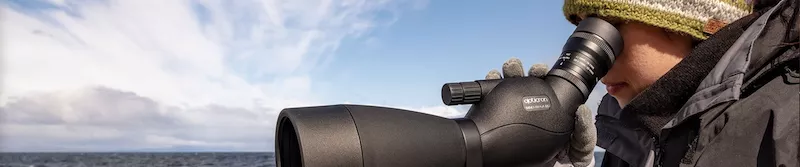 When observing against the light with a standard instrument, it is possible to perceive a bluish or reddish fringe around the contours of a dark subject on a light background. This phenomenon, known as chromatic aberration, is one of the main optical defects of entry-level spotting scopes.
To remedy this, manufacturers have developed highly corrective glasses – referred to by brands as ED, HD, APO, Prominar, LO… Their effect is subtle at low magnification (15x to 30x), but becomes clearly perceptible at high magnification (40x, 50x, 60x): the image gains in contrast, precision, and color fidelity.
These high-definition optics are essential in three situations:
- Difficult weather conditions (fog, backlight, low-angle light)
- Fine color recognition, especially in ornithology
- Photography through the spotting scope (digiscoping)
The optical quality
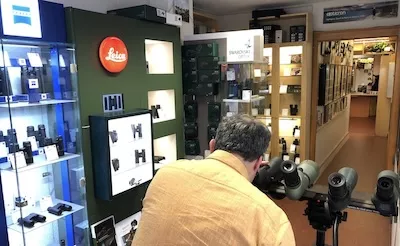 The optical quality of a spotting scope is assessed on four fundamental criteria: image distortion, edge sharpness, color rendering, and resolution. Qualities that only truly reveal themselves under real conditions.
Our advice: come test our models in-store – it’s the only way to find the spotting scope that truly meets your expectations and your eye.
The optical treatment
Almost all spotting scopes benefit from an anti-reflective coating on their lenses, designed to maximize light transmission and image clarity. However, the quality of this coating varies significantly from model to model – and directly affects brightness, contrast, and color fidelity.
A quality anti-reflective coating means a brighter, more contrasted, and more pleasant image to the eye.
The field of view
The field of view refers to the width of the visible landscape through your spotting scope, measured at 1,000 meters away. It is expressed in meters (m) or in degrees (°) – and the wider it is, the more comfortable and intuitive the observation is, especially for tracking a moving subject.
The weight
For hiking, the weight of the spotting scope is a criterion not to be overlooked. A model that is too heavy will quickly become a burden in the field – prefer a compact and lightweight model for itinerant outings.
The tripod
Essential for any spotting scope, the tripod ensures a stable and vibration-free image. The choice of model directly depends on your usage: lightweight and compact for field outings, more robust and stable for fixed and prolonged observation.
A good tripod guarantees comfortable observation – an investment not to be neglected.
After-sales service
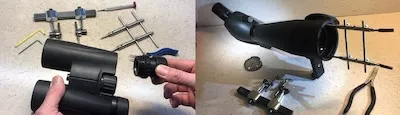 We know that an instrument used in the field is exposed to the uncertainties of daily life – shocks, falls, natural wear. That’s why we offer attentive after-sales service, in close collaboration with manufacturers, to ensure the replacement of wear parts and necessary repairs, at controlled costs.
The warranty – what it really covers
The warranty is often misunderstood. It is by no means a comprehensive insurance: it exclusively covers manufacturing defects and faults, independent of any intervention or use by the user.
It does not apply in the event of shock, fall, normal wear, or non-compliant use according to the manufacturer’s recommendations.
In practice, a manufacturing defect – on a pair of binoculars, for example – generally manifests itself from the first uses. As for the displayed warranty duration, it is more of a commercial argument than a technical reality: neither shocks nor wear are covered, regardless of the announced duration.
In summary: use your instrument with care, and the after-sales service will rarely need to intervene.
The advice of the experienced ornithologist
An experienced observer never chooses an instrument at random: he always buys the one he has personally tried and tested. Because a device taken out of its packaging may conceal an imperceptible defect without the conditions of a real optical test. A good reason to come visit us in-store.