
Omegon Set of 6 filters - Ø 31.7 mm
Available in 8-15 days
89,00 CHF
Optique Perret, your Swiss specialist
in optical instruments
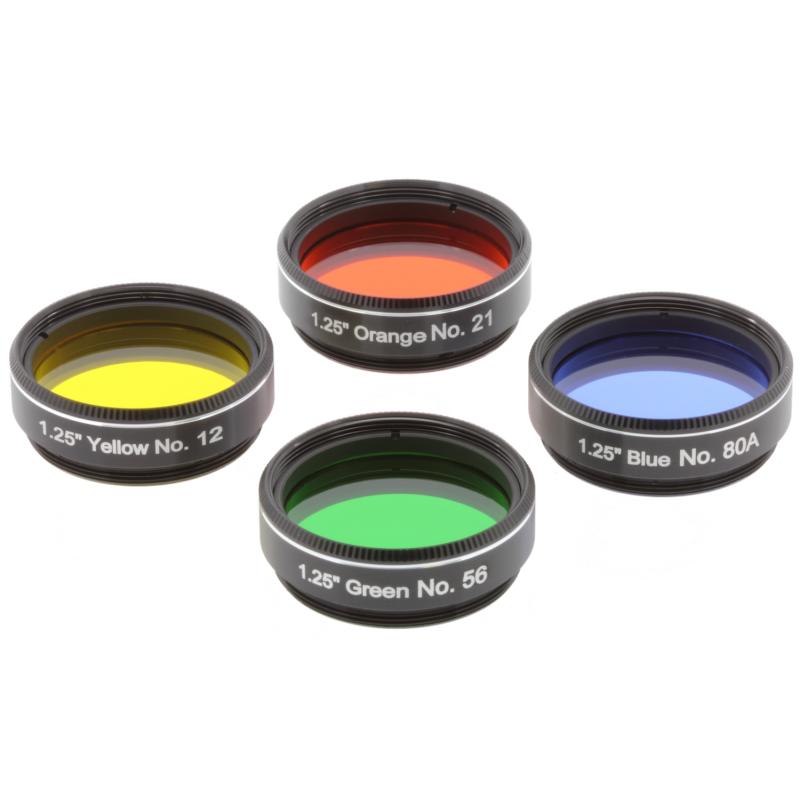

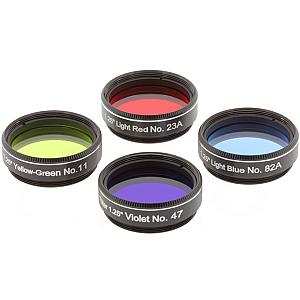
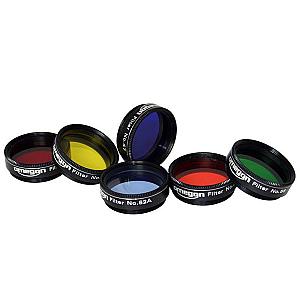
Filter set No. 2, Moon & Planets, for an aperture starting from 50 mm.
Brand-new product
What are these color filters for? Do we really need color filters?
Color filters slightly darken the light that reaches your eyes or the sensor of your camera. This filter helps eliminate any risk of overexposure. They make the image even more contrasted, and no detail, even the smallest, can escape you.
FEATURES
DELIVERY CONTENTS
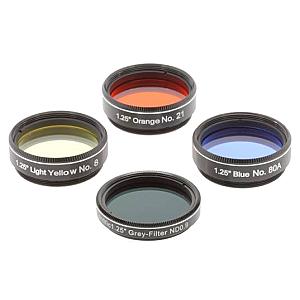
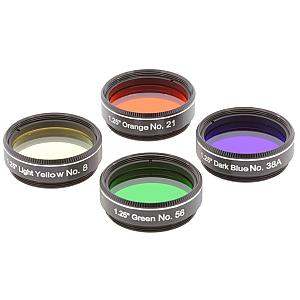
EXPLORE SCIENTIFIC Filter 31.7 mm - Green No. 56
The green filter significantly increases the contrast between the red and blue areas of cloud structures on the gas planets Jupiter and Saturn. On the Moon, the contrasts are clearly visible on the crater rims.
EXPLORE SCIENTIFIC Filter 31.7 mm - Orange No. 21
Facilitates the recognition of dark areas on the planet Mars. This filter also allows you to identify even more details of the cloud bands on Saturn and Jupiter.
EXPLORE SCIENTIFIC Filter 31.7 mm - Yellow No. 12
When observing the surface of the Moon, the contrast is significantly improved. The same goes for the planet Mars. On the massive planet Jupiter, the contrast between the different cloud bands is greatly enhanced, allowing you to see more and more new things. With a telescope of at least 8 inches in diameter and under excellent observing conditions, you may even be able to identify objects on Saturn. Recommended for telescopes with an aperture of at least 3.5".
EXPLORE SCIENTIFIC Filter 31.7 mm - Blue No. 80A
The blue color facilitates the observation of high nebulosity on the planet Mars. The contrast improves. The dark red structures are represented even darker, making this filter the perfect tool for observing the large red markings on the gas planets Jupiter. The ring of Saturn is highlighted, and the structures of Venus's atmosphere become finer.
Optique PERRET - Telescope & Binocular Center - is a family business, active since the last century in the field of optics.
for items in stock in Geneva
don't hesitate to call us 022 311 47 75