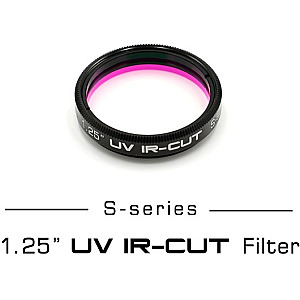

Player One - UV IR-CUT (Ø 31.7 mm)
Available in Geneva
36,00 CHF
Optique Perret, your Swiss specialist
in optical instruments
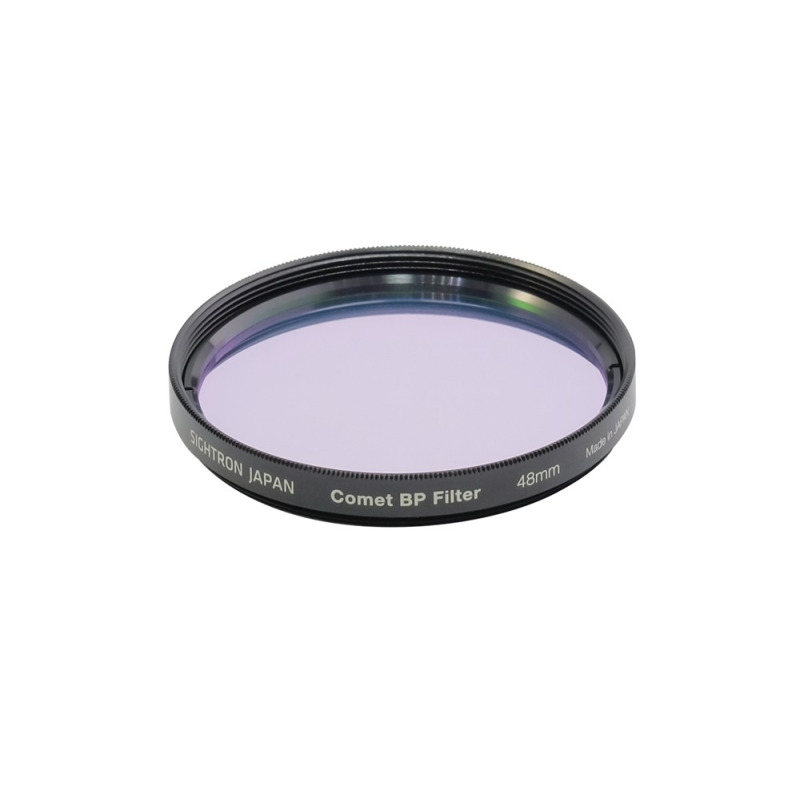
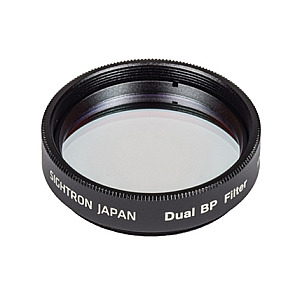
The Sightron Comet BP filter (Comet Bandpass) is an interference filter that transmits the four main emission lines of celestial objects. Emission lines Hα, Hβ, OIII, and SII Emission lines CN, C2, and C3 from the core and tail of comets Diameter Ø 31.7 mm
Brand-new product
The Sightron Comet BP filter (Comet Bandpass) is an interference filter that transmits the four main emission lines of celestial objects, Hα, Hβ, OIII, and SII, and also transmits the emission lines close to CN, C2, and C3 from the core and tail of comets, while cutting out the rest of the wavelength range.
It can be used as a light pollution filter to enhance the contrast of low comets, reflection nebulae, galaxies, and star clusters in poor conditions that are obscured by light pollution.
Product Features
Transmits the comet's emission lines
Transmits the four main emission lines of celestial objects in the Hα, Hβ, OIII, and SII wavelength range, as well as the emission lines close to CN, C2, and C3 from the core and tail of comets, and cuts out other wavelength ranges, making comets and nebulae visible even in light-polluted areas. The relatively balanced transmission of celestial light, from short to long wavelengths, also makes it difficult to disturb the color balance of stars and nebulae.
Reliable quality from Japan
Synthetic quartz glass is used as the substrate. It is stronger and more heat-resistant than the optical glass normally used, so distortion during coating is even lower than usual, and the stability and precision of the coating surface are excellent. The filter prevents image deterioration, even when photographing planets at high magnification. Made in Japan by a major Japanese optical equipment manufacturer.
Universal thread diameter 31.7 mm (1.25")
Standard diameter of Ø 31.7 mm that can therefore be used with many telescopes.
Besides comets, these filters are excellent for the color representation of blue stars and blue reflection nebulae.
Sky-Watcher BKP130OTAW F5 frame collector / ISO3200 180s / 24 stacks
Photo by the Schmidt team.
In the case of galaxies and star clusters emitting light in a continuous spectrum, the Comet BP filter is capable of producing richer and more natural colors than the Quad BP filter, which only transmits four emission lines.
Sky-Watcher BKP130OTAW Image collector F5 / ISO3200 180s / with white balance and exposure compensation
Although the Quad BP filter is superior in terms of its ability to reduce light pollution, the Comet BP filter excels in rendering colors more naturally. It is particularly recommended for objects that require a natural color representation, such as galaxies, star clusters, and reflection nebulae that emit light in a continuous spectrum.
.
We recommend using the Quad BP filter for shooting in urban areas where light pollution is particularly significant or for emission nebulae, and the Comet BP filter for comets and galaxies.
Optique PERRET - Telescope & Binocular Center - is a family business, active since the last century in the field of optics.
for items in stock in Geneva
don't hesitate to call us 022 311 47 75